.png)

Continuous Provision
Continuous Provision
Play is the highest form of research - Albert Einstein
In Early Years and Year 1, we use a teaching and learning approach called Continuous Provision where carefully planned environments enable children to pursue their own interests during 'self-led learning time'. Research shows that young children benefit from a curriculum that is play-based and 'hands on' and where there is a greater degree of choice. Piaget (1952) described the stage of development between 2 and 6 years as being a time when children learn to use language, begin to represent ideas using pictures and objects and are highly active, learning through pretend play and first-hand experiences. The use of Continuous Provision beyond Early Years and into Key Stage 1 is also supported by Early Excellence, an organisation that is established as a national leader in the pedagogy and practice of teaching young children.
Continuous provision refers to the core learning areas in our classroom that stay available every day. These are the areas pupils know they can go to independently, whether that’s construction, small world, creative, reading, maths, phonics, or role play.
The key word is continuous. The resources don’t change all the time, and that’s intentional. When pupils know what’s available and where it lives, they become more confident using it. Over time, we'll often see pupils planning their play, returning to unfinished ideas, or using resources in more thoughtful ways without needing adult input.
Examples of continuous provision areas we have included in ourclassroom are:
- Small world – supports storytelling, role play, and exploring real-life scenarios using figures, vehicles, and settings.
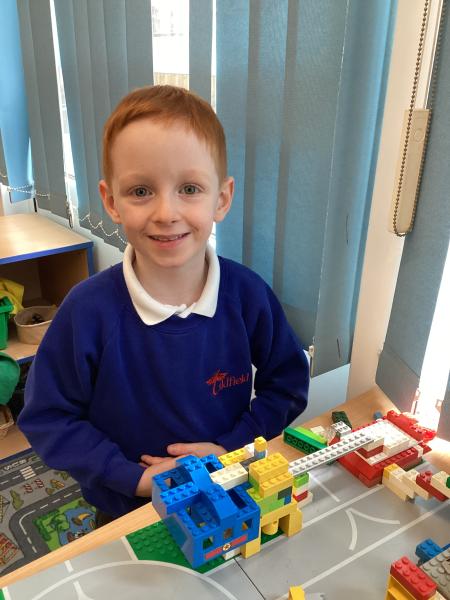
- Construction – encourages problem solving, collaboration, and developing spatial awareness through building and design.
- Reading area – a calm, inviting space where pupils can choose books independently and develop a love of reading.
- Creative area – provides opportunities to explore materials, colour, and texture through art and craft activities.
- Maths area – offers hands-on resources to support number, counting, shape, pattern, and early problem solving.
- Phonics area – allows pupils to practise sounds, blending, segmenting, and mark making linked to phonics learning.
- Role play – gives pupils the chance to explore familiar experiences, act out ideas, and develop language through imaginative play
Allowing pupils access to continuous provision gives them time to consolidate learning from adult-led teaching and apply skills independently. It also gives pupils the chance to explore ideas and concepts through play, sometimes before they have been taught them formally.
Transition from Reception
Transitioning from Reception to Year 1 can be a big change for children. Continuous Provision helps make that shift smoother and more successful by continuing familiar routines, environments, and learning styles—while gradually increasing challenge.
Here’s why it’s so valuable:
• Bridges the transition: Children move smoothly from play-based EYFS learning to more formal KS1 structures.
• Develops independence: Children learn to make choices, take responsibility, and direct their learning within a safe, well-planned space.
• Boosts engagement and confidence: Learning feels fun, relevant, and accessible, building children’s confidence to try new things.
• Links play to learning: Each area supports National Curriculum outcomes—such as writing recipes in the mud kitchen or counting money in a cafe setup.
• Promotes deeper learning: Children revisit concepts, apply knowledge, and extend their thinking independently.